
Gyaffing
Has it happened with you, dear reader, that you come across a new word and feel that it sounds precise? The nature of this precision is unclear but somewhere in the back of your mind you know that it can be used to describe something in way that no other word would do. All this only based on the sound of the word. Then you see the meaning and feel disappointed because the word means something completely different and you are out there resolving yet another dilemma - should I use the word to mean what it sounds like or should I be a slave to the dictionaries? For example, I always thought ‘prepare’ means to not do anything about the thing you’re supposed to be ready for - exams, interviews etc. The reason was simple. The word ‘pare’ means to cut down or trim. ‘Pre’ means before the event. So pre-pare should mean to cut down on things you’re supposed to do for the event - studying for exams or mugging up falsities for job interviews. But it means the exact opposite.
It is rare that you’re impressed by the sound of the word, guess its meaning, and it turns out to mean exactly the same. I recently discovered one such word - gyaff. This is what Oxford English Dictionary says about it -
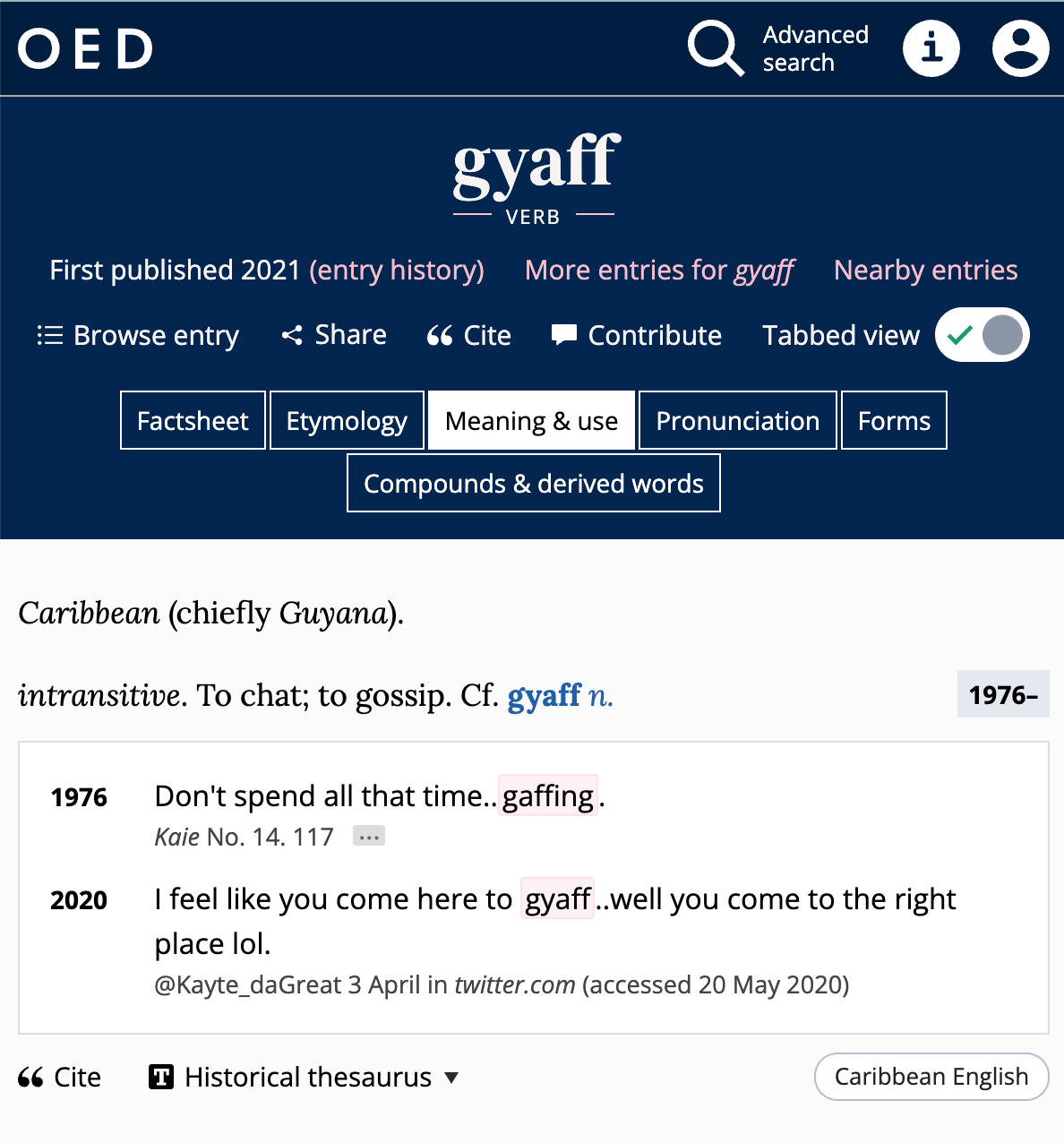
I encountered this word in a novel1 set in the Caribbean country of Guyana. I first thought it was a distortion of the word ‘gaffe’, which means something stupid or embarrassing said in public. The way ‘pace like fire’ becomes ‘pyace like faya’. But it isn’t true. Gyaff is not gaffe said in the Caribbean accent. It has an independent existence. Every time I read this word in the novel, I kept falling in love with it. Not because I am a weirdo who fantasises about words but because every time this word was mentioned in a scene, I wanted to be there, well, gyaffing. Take these for example -
‘Sometimes we would shoot arrows at tins with a bow Foulis had made or kick about a deflated football. We’d find a spot and gyaff.’
or
‘... I ah tell you the problem. Too much politricks. Politricks, you hear. Ha! G’lang bai, but you must come down fuh gyaff.’
Who wouldn’t want to come down to gyaff?
There are other words that come close to meaning what gyaff means but none of them is as perfect. Gossip sounds too casual, discuss too formal, blabber too derogatory. The Hindi word bakar sounds too benign, bakwaas too crass, badbad too boring. Beyond this, the words that come close, refer directly or indirectly to private body parts or whatever comes out of them. Gas around, for example, immediately makes you mockingly pinch your nose between your forefinger and thumb; the Hindi word bakchodi, with its sexual reference, makes you wonder how can words be humped; and chit-chat, chatter, babble, ramble, gabble sound repulsive. Even the literal talking has become something else altogether. When was the last time you responded positively to let’s talk? On the other hand, if someone said let’s gyaff to me, I would look for the most comfortable spot to sit and start gyaffing about the first thing that comes to my mind. At this moment, it would be elephants desperately flapping their huge ears, trying to fly.
It is not the first time that I have come across a word this precise but it’s the first time I have come across a word this precise that does not invoke genitalia. The last one was a Hindi word that rhymes with bhootiya. I’ll call it the c-word. We named one of our friends the c-word. It doesn’t sound like a big deal. If you are an Indian male of my age, you have been called the c-word at least once in your lifetime. The difference here is that my friend was, as Oscar Wilde would have said if he had met him, in every way the visible personification of absolute bhootiyagiri (replace b with c and read again). Being occasionally called the c-word and being a precise mascot of it are two completely different things altogether. Just to clarify, dear readers, I myself am not this ‘friend’ and if it helps my case, I would not shy away from identifying him. But it won’t serve anyone any good.
For a long time I thought it was not possible to have such a precise word without invoking genitalia. But gyaff has solved that problem for me. I might even name this newsletter ‘Gyaffing with Grumpy’.
The Sly Company of People Who Care by Rahul Bhattacharya